
PRK and SMILE refractive surgery in Medellín
Two ways to correct your prescription with laser, without lifting a flap in the cornea
If your cornea is thin, you play contact sports or you simply do not want a flap, PRK or SMILE may be the right option for you. MDE Care is not a clinic: we connect you with refractive surgeons in Medellín and arrange your assessment, the surgery and your follow-up visits.
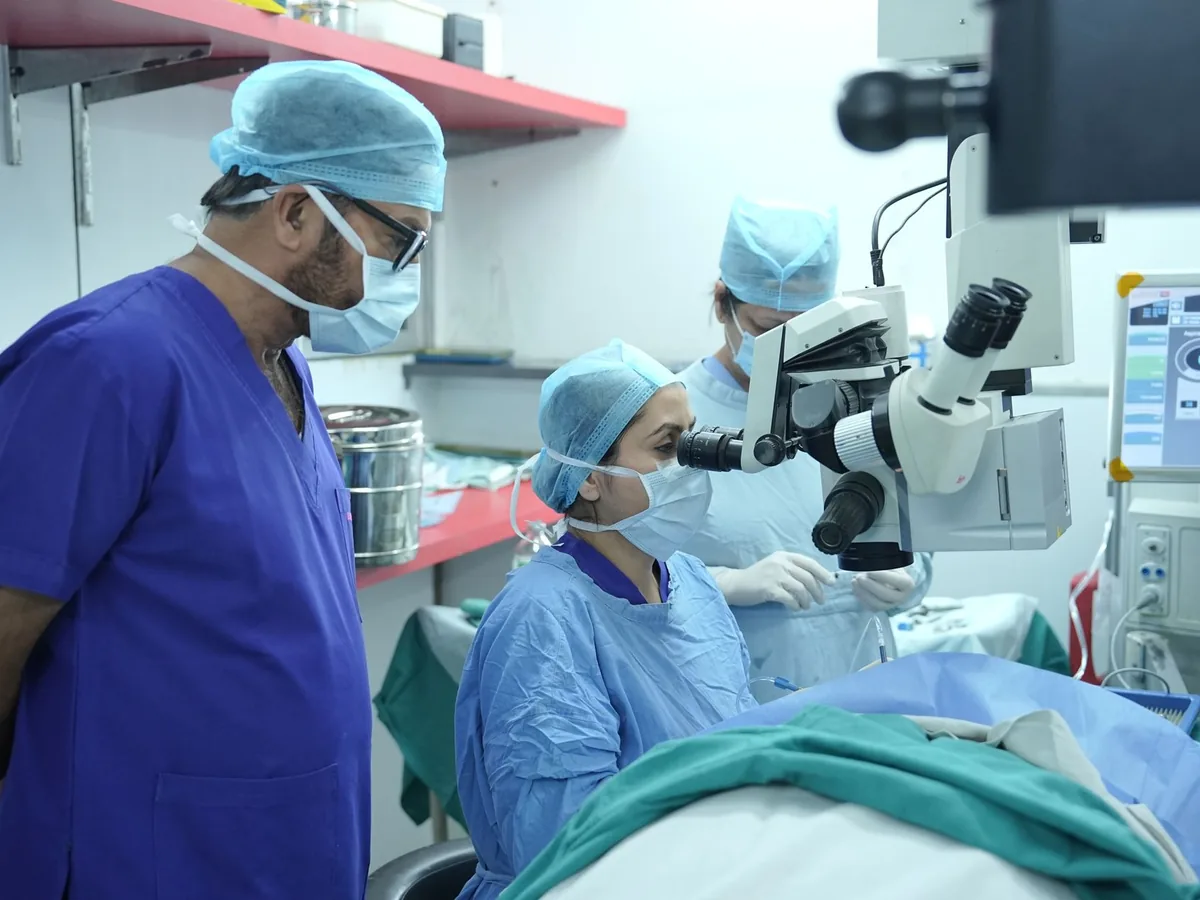
Outpatient surgery
with anesthetic eye drops
Technique comparison: PRK, SMILE or LASIK, which one suits you?
All three correct your prescription with laser, but they do not behave the same way. Tick what matters to you and we show you which one usually suits your case best and how they differ.
What matters to you?
Tick all that apply.
Your guidance result
Tick your priorities
Based on what you tick we work out which technique usually suits you best. Meanwhile, the table below shows all three side by side.
| What to compare | PRK | SMILE | LASIK |
|---|---|---|---|
| Corneal flap | No. The surface layer is removed and the laser works on it | No. A lenticule is removed through a 2 to 3 mm micro incision | Yes. A flap is created with a femtosecond laser |
| Discomfort in the first days | It can hurt for 2 or 3 days, controlled with pain relief | Almost painless recovery | The surgeon explains it during the assessment |
| Back to normal life | Driving and working between day 3 and day 6 | One or two days | Visual recovery in 24 hours |
| Optimal vision | Improves in 3 to 5 days, optimal at around one month | Gradual improvement over days and weeks | Confirmed at follow-up visits |
| What it corrects | Nearsightedness, farsightedness and astigmatism | Nearsightedness from -1 to -10 and astigmatism up to 3 diopters, according to FDA approval. Not farsightedness | Nearsightedness, astigmatism and farsightedness, within the ranges the surgeon defines |
| Suitable for contact sports | Yes, since there is no flap | Yes, since there is no flap | With caution: the flap can shift with a blow |
| Guide price, both eyes | COP 2,800,000 to COP 3,500,000 | COP 7,000,000 to COP 14,000,000 | COP 6,000,000 to COP 12,000,000 |
Interested in the technique with a flap? See LASIK refractive surgery in Medellín.
* Guidance only, not medical advice. The surgeon defines the technique with your tests: corneal thickness and shape, prescription and stability. Sources: American Academy of Ophthalmology (AAO) and EyeWiki for PRK and SMILE; MDE Care procedure page for LASIK. PRK and SMILE prices: market ranges in Colombia, confirmed during the assessment.
How much PRK and SMILE cost in Medellín
Pick the technique and see a guide range for both eyes, in Colombian pesos or in dollars. If you used the comparison, we have already selected the technique it recommended.
1. Which technique would you like a quote for?
2. Add the pre-surgical assessment?
Before surgery
The assessment decides the technique
It is not chosen from a catalog. The surgeon examines your cornea and your prescription and confirms whether you are a candidate for PRK, SMILE or another option. That is why the final price is set after the assessment.
What is checked
- Corneal thickness and shape
- Your prescription and how stable it is
- The eye surface, to rule out dry eye
- The technique that best fits your tests
If the tests show very high nearsightedness or a very thin cornea, the alternative may be the ICL phakic lens.
Market guide range · both eyes
COP 2,800,000 to COP 3,500,000
PRK · both eyes
Market guide range, confirmed during the assessment.
Pre-surgical assessment with tests
COP 400,000
Optional. Tick it above to add it.
* Market guide prices for both eyes. Dollar amounts are a reference conversion and may change with the exchange rate of the day. The final price is confirmed during the assessment, based on the technique indicated and the assigned clinic.
What are PRK and SMILE?
PRK and SMILE are laser surgeries that reshape the cornea to correct your prescription, without creating the flap that LASIK uses. In PRK the outermost layer of the cornea is removed and the laser is applied to it. In SMILE, a laser shapes a small disc inside the cornea, which is removed through a minimal incision.
PRK is neither an old technique nor a worse one. It is very useful for thin corneas and for people with very active lives, and according to the American Academy of Ophthalmology about 9 out of 10 patients end up with 20/40 vision or better without glasses. What changes is the recovery: the first days are more uncomfortable and vision takes longer to clear.
The surgeon defines the technique with your tests, which are reviewed in a complete eye assessment. If your tests make you a candidate for the technique with a flap, also see LASIK refractive surgery.
PRK or surface ablation
The surface layer of the cornea is removed and the laser reshapes it. Then a therapeutic contact lens is placed while it heals.
SMILE or lenticule extraction
A femtosecond laser shapes a lenticule inside the cornea, which is removed through a small incision, with no flap.
The difference from LASIK
LASIK lifts a flap in the cornea. PRK and SMILE do not, which favors very active people.
If the prescription is very high
When the prescription is very high or the cornea is not thick enough for laser, there is the ICL phakic lens.
Who is a candidate for PRK or SMILE?
These are the criteria the surgeon reviews before proposing one technique or the other.
Age
PRK is done from age 18, ideally after 21. SMILE, from age 22.
Stable prescription
At least one year without changes for SMILE. Many clinics ask for two years for any refractive surgery.
Thin cornea
When the cornea is not thick enough for a flap, PRK is a common option.
Contact sports or high-risk jobs
Contact sports, the armed forces or jobs with a risk of blows to the face favor techniques without a flap.
Existing dry eye
It is best resolved before surgery. It is checked during the assessment.
Not always the only option
Very high nearsightedness or very thin corneas may be treated with an ICL phakic lens, which corrects vision without touching the cornea.
If you are over 40 and already struggle to see up close, the conversation includes age-related near vision loss: see presbyopia surgery.
How are PRK and SMILE performed?
Both are outpatient procedures and take only a few minutes. What changes is how the surgeon reaches the corneal layer that is reshaped.
PRK, the surface technique
Anesthetic eye drops. The eye is numbed with drops; the surgery does not hurt.
Laser on the surface. The surface layer of the cornea is removed and the laser reshapes it. It all takes about 15 minutes.
Therapeutic contact lens. It is placed while the surface heals.
Follow-up and drops. There is a check-up the next day, and corticosteroid drops are used for up to 4 months to prevent corneal haze.
And SMILE
A femtosecond laser shapes a lenticule inside the cornea and the surgeon removes it through a small incision. No flap is lifted and the surface layer of the cornea is preserved.
The procedure takes 10 to 15 minutes, with only about 30 seconds of laser. Most people return to their activities in one or two days.
What changes and what does not with PRK and SMILE
PRK is more uncomfortable in the first days. This is normal and is managed with pain relief and drops.
No flap means no flap that can shift. That is why these techniques are preferred for athletes and for jobs with a risk of blows.
After PRK, corticosteroid drops are used for up to 4 months, to prevent corneal haze.
No technique stops presbyopia. After 40, near vision changes anyway. If it is already happening to you, see presbyopia surgery.
Practical information
| Duration | PRK: about 15 minutes. SMILE: 10 to 15 minutes |
| Anesthesia | Anesthetic drops for PRK. For SMILE it is confirmed with the clinic |
| Hospital stay | Outpatient: you go home the same day |
| Back to normal life | PRK: driving and working between day 3 and day 6. SMILE: one or two days |
| Vision recovery | PRK: optimal vision at around one month. SMILE: gradual improvement over days and weeks |
| Follow-up | Check-up the next day; after PRK, corticosteroid drops for up to 4 months |
| Remote follow-up | Later follow-up visits can be done remotely when the specialist considers it safe, so you do not have to stay in Medellín longer than necessary |
Why arrange your PRK or SMILE with MDE Care
We are not a clinic: we are your coordination team. We connect you with refractive surgeons in Medellín and support you from start to finish.
Refractive surgeons
We connect you with refractive surgery specialists at clinics in Medellín, who define the technique with your tests.
Clear pricing before you decide
We give you a guide range from the first message and the final price after the assessment, with no surprises.
Remote follow-up
When the specialist considers it safe, later follow-up visits are done remotely and you do not have to stay longer than necessary.
Organizations that endorse our work

How we arrange your PRK or SMILE surgery in Medellín
A clear process with support at every stage, from your first message to your follow-up visits.
Tell us about your case
Message us on WhatsApp with your prescription or your previous tests. We guide you on techniques and prices.
Assessment with tests
We arrange the assessment where the surgeon measures your cornea and confirms whether you are a candidate.
Plan and final price
Once the technique is defined we confirm the final price and the surgery date.
Surgery day
Outpatient surgery that takes a few minutes. We are with you on arrival and departure.
Follow-up
A check-up the next day and later visits done remotely when the specialist considers it safe.
Everything about PRK and SMILE in Medellín
Which is better: PRK, SMILE or LASIK?+
None is better for everyone. It depends on corneal thickness, your prescription and your lifestyle, and the surgeon decides based on your tests. PRK and SMILE do not create a flap, which favors people who play contact sports; SMILE is not approved for hyperopia.
Does PRK hurt?+
The surgery itself does not, because the eye is numbed with drops. In the following 2 or 3 days there may be pain, which is controlled with pain relievers and eye drops.
How long is PRK recovery?+
Vision improves in 3 to 5 days and stabilizes at around one month. Many people return to work and driving between day 3 and day 6. Corticosteroid drops are then used for up to 4 months.
Does SMILE correct hyperopia?+
FDA approval for SMILE covers myopia from -1 to -10 and astigmatism up to 3 diopters, not hyperopia. PRK does treat hyperopia.
Can I have surgery if my cornea is thin?+
PRK is a common option for thin corneas because it does not need a flap. If the cornea is not thick enough even for that, there is the ICL phakic lens, which corrects the prescription without touching the cornea.
What results can I expect?+
According to the American Academy of Ophthalmology, about 9 out of 10 people treated with PRK end up with 20/40 vision or better without glasses. It is a reference figure, not a promise: the result depends on each case.
How much do PRK and SMILE cost in Medellín?+
As a guide market range in Colombia, PRK costs COP 2,800,000 to 3,500,000 for both eyes (about USD 700 to 875) and SMILE COP 7,000,000 to 14,000,000 for both eyes (about USD 1,750 to 3,500). The pre-surgical assessment with tests is around COP 400,000. The final price is confirmed at the assessment.
Do you already have corneal tests?
Send them to us and we tell you whether an assessment for PRK or SMILE makes sense.
Other ophthalmology procedures
Ready to leave your glasses behind with PRK or SMILE?
Tell us your prescription and what matters to you. We arrange your assessment with a refractive surgeon in Medellín, the surgery and your follow-up visits, with clear pricing from the start.