
Low vision and orthoptics in Medellín
When glasses are no longer enough or the eyes do not work as a team, there is still a lot to do
Low vision rehabilitation aims to make the most of the vision you still have, with optical aids and training. Orthoptics treats how both eyes work together, for example when you see double or get tired reading up close. We tell you honestly what vision therapy can and cannot do. MDE Care is not a clinic: we arrange your assessment with specialized optometrists and ophthalmologists in Medellín.

Low vision is not blindness
the vision you have left can be put to use
Low vision rehabilitation or orthoptic therapy?
Tell us what is happening and we show you which assessment fits, what is checked, how much the first step costs and what to keep in mind if you are traveling.
1What bothers you the most?
Choose the option that best describes you, or the person you are helping.
2How old is the patient?
3Do you have a diagnosis that affects your vision?
For example, macular degeneration, glaucoma or diabetic retinopathy.
4Do you live in Medellín or are you traveling?
It matters because orthoptic therapy is a series of sessions, not a single visit.
Answer step 1 to begin.
Answer step 1 to see your path
Based on what is happening, we show you whether a low vision assessment, an orthoptic assessment or first a full eye exam is the right step.
Next step
- Low vision assessment: for people who see poorly even with glasses
- Orthoptic assessment: for when the eyes do not work as a team
What is checked
- Depends on the assessment that fits
Guide price of the assessments
COP 80,000to COP 160,000
Orthoptics COP 80,000 to COP 150,000. Low vision COP 120,000 to COP 160,000.
* Guide prices, confirmed at the assessment. Guide result, not a diagnosis.
How much does a low vision or orthoptic assessment cost in Medellín
Build your case: the assessment you need, the orthoptic therapy sessions and the optical aids. We show you the guide total in pesos or dollars.
First, the assessment
Everything starts with an assessment: in low vision it measures how much you see, which tasks are hard for you and which aids help you; in orthoptics it measures how both eyes work together. With that, the specialist decides whether therapy is needed, how many sessions and which aids to prescribe.
What is included
- Acuity and visual field, tasks that are hard for you and aids trial
- Follow-ups, some remote when the specialist considers it safe
What changes the price
- Which assessment you need and whether both are needed
- Whether the specialist recommends therapy
- The assigned professional and center
1. Which assessment do you need?
If you have never had a full eye exam with optometry, it is best to start there: it rules out that new glasses would solve the problem.
2. Orthoptic therapy sessions
COP 70,000 to COP 120,000 per in-office session, plus home exercises. This is a simulation: the specialist decides the real number of sessions. In clinical studies, programs lasted 12 to 16 weeks.
3. Optical aids
Guide total
COP 120,000to COP 160,000
Low vision assessment
Breakdown
- Low vision assessmentCOP 120,000 to COP 160,000
* Guide prices, confirmed at the assessment. Guide result, not a diagnosis.
What low vision is
Low vision is a loss of sight that makes daily activities difficult and cannot be corrected with glasses, contact lenses, medication or surgery.
It is not blindness. The World Health Organization defines it as visual acuity worse than 20/60 or a visual field narrower than 10 degrees with the best correction, in a person who uses or can use their vision for tasks.
Having no cure does not mean nothing can be done: rehabilitation aims to make the most of the vision that remains. The most common causes include macular degeneration, glaucoma and diabetic retinopathy, which keep being treated while vision is rehabilitated.
It is not blindness
Useful vision remains, and the idea is to make the most of it.
Glasses are no longer enough
With an up to date prescription you still cannot read or recognize faces.
The goal is independence
Reading, cooking, recognizing faces and getting around more safely.
What is checked in a low vision and orthoptic assessment
They are non-invasive assessments, with no anesthesia or hospital stay, designed to measure how you use your vision in real life.
Who does what in your assessment
Aids for low vision
They are tried during the assessment and chosen for the task you want to get back. Not every aid works for everyone.
Magnifiers
For reading, seeing labels or doing close-up tasks.
Telescopes
For seeing far away, such as signs or the television.
Filters and lighting
Anti-glare filters and more light where you do your tasks.
Digital magnification
Contrast and font size settings on your phone and computer, and electronic magnification.
Training
Learning to use the aids, adapting your home, orientation and mobility, and self-care.
Treating the cause
Treating the underlying disease can protect the vision you have left, for example with retina surgery or glaucoma control.
What orthoptics is and when to see a specialist
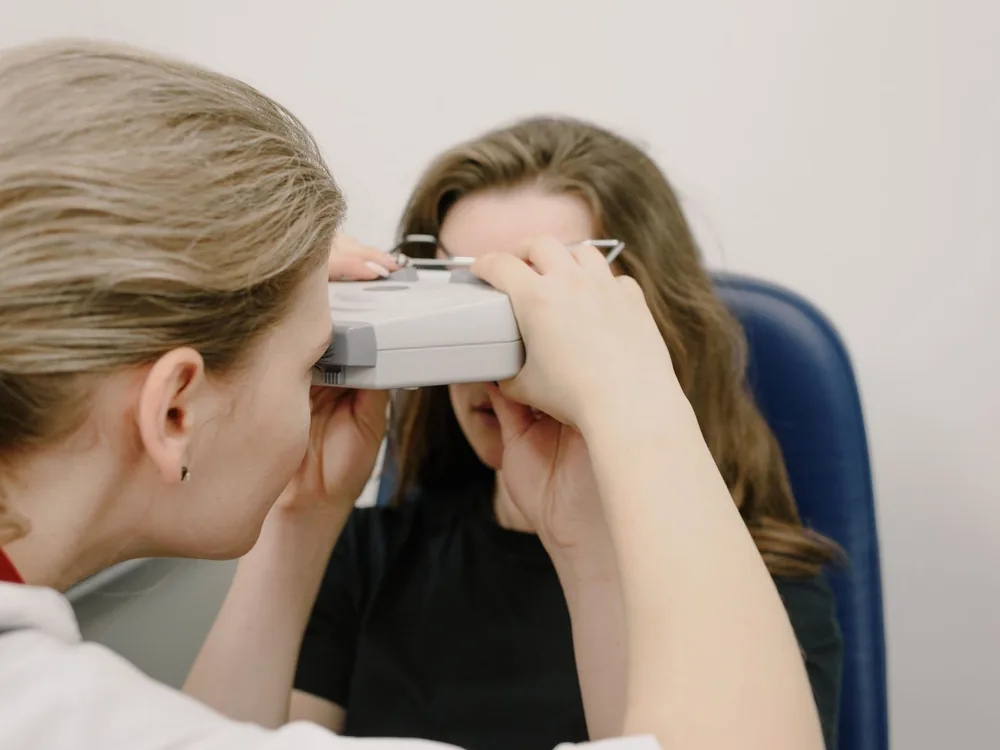
Orthoptics diagnoses and treats binocular vision disorders, that is, how both eyes work together: the eye muscles, focusing and amblyopia. These signs mean an assessment is worth it.
What vision therapy can and cannot do
We tell you because almost nobody explains it. It is based on the reference clinical trial on convergence insufficiency.
What it can do
- Improve the symptoms and visual function of convergence insufficiency: double vision up close, tiredness and headaches when reading.
- In that trial, about 75% of children treated with in-office sessions plus home exercises reported that their symptoms resolved or improved.
- Help the eyes work in a coordinated way, with a plan set by the specialist.
What it cannot do
- Promise better reading or school performance: the study that measured it found no such improvement.
- Treat dyslexia or other learning problems. It should not be presented as a treatment for them.
- Restore vision lost to low vision: there, what helps is rehabilitation with optical aids.
If it was recommended for learning
A full assessment first: an optometry eye exam and an orthoptic assessment. If convergence insufficiency shows up, therapy can relieve the visual symptoms, but it does not replace the assessment or learning support.
Who each assessment is for
Low vision assessment
For people who see poorly even with glasses, especially with macular degeneration, advanced glaucoma or diabetic retinopathy.
COP 120,000 to COP 160,000, guide price
Orthoptic assessment
For children and adults with double vision up close, tiredness when reading or a lazy eye that remained after treatment.
COP 80,000 to COP 150,000, guide price
Untreated children
If a child has a lazy eye and has not been treated yet, the assessment starts in pediatric ophthalmology.
Pediatric ophthalmologist first
Low vision and orthoptics at a glance
| Type of assessment | Non-invasive: no anesthesia or hospital stay |
|---|---|
| Low vision assessment | COP 120,000 to COP 160,000, guide price |
| Orthoptic assessment | COP 80,000 to COP 150,000, guide price |
| Orthoptic therapy session | COP 70,000 to COP 120,000 per session, guide price |
| Program in studies | 12 to 16 weeks, in the office plus home exercises |
| Therapy plan | Set by the specialist for your case |
| Optical aids | Tried during the assessment and quoted by aid |
| If you travel | Later follow-ups can be done remotely when the specialist considers it safe |
Why arrange your low vision or orthoptic assessment with MDE Care
We are not a clinic: we are your coordination team. We connect you with specialized optometrists and ophthalmologists in Medellín.
The right assessment
We guide you to low vision, orthoptics or first a full eye exam, based on what is happening.
Honest expectations
We tell you what vision therapy can and cannot do before you pay for a series of sessions.
End-to-end coordination
Assessment, sessions, aids, follow-ups and, if you travel, the logistics of your stay in Medellín.
Organizations that support our work

How we arrange your low vision and orthoptic assessment
A guided process from your first message to your follow-ups.
Tell us your case
Write to us on WhatsApp with what is happening or your self-check result.
Assessment
Low vision, orthoptics or both, depending on what you need.
Plan
The specialist sets the aids and, if needed, the therapy sessions.
Aids and therapy
Training with the aids or in-office sessions plus home exercises.
Follow-ups
In person and remote when the specialist considers it safe.
Most asked questions about low vision and orthoptics
What is low vision?
Can low vision be cured?
What is orthoptic therapy or vision therapy?
Does vision therapy help with dyslexia or school performance?
How long does orthoptic therapy last?
How much does a low vision or orthoptic assessment cost in Medellín?
Can I do the therapy if I come from another city or country?
What if my child has a lazy eye?
Are your glasses no longer enough?
Tell us what is happening and we help you book the right assessment.
Other ophthalmology procedures
Ready to make the most of your vision?
Write to us with what is happening or your self-check result. We arrange your low vision or orthoptic assessment, aids, therapy and follow-ups in Medellín, with a clear price from the first message.