
Percutaneous nephrolithotomy in Medellín
Surgery for large and staghorn kidney stones
Percutaneous nephrolithotomy removes large kidney stones through a small puncture in the back. It is the technique that clears the kidney most completely in a single procedure when the stone is larger than 20 mm. MDE Care is not a clinic: we coordinate the assessment with the urologist, the tests, the surgery and your stay in Medellín.
Support
from the CT scan to the follow-up
How complex would your percutaneous surgery be?
The shape and size of the stone, infections, kidney anatomy and anticoagulants change the number of access tracts, the length of the hospital stay and whether a second procedure will be needed.
1. How does your report describe the stone?
2. Have you had repeated urinary tract infections, or were you told it is an infection stone (struvite)?
3. Do you have any of these conditions? (you may select several)
4. Do you take anticoagulants or antiplatelet drugs?
Your guidance
Answers missing
Please complete the questions to see your guidance.
* Guidance based on the urolithiasis guideline of the European Association of Urology (EAU) and the surgical guideline of the American Urological Association (AUA). Final planning is done with the CT scan and the urologist.
How much percutaneous nephrolithotomy costs in Medellín
Select the tests you do not have yet, what you may need afterwards and the stay if you are coming from another city. We show you the price of each part and the estimated total.
Surgery
If residual stone remains
Before surgery
Select what you do not have yet.
After surgery
Stay in Medellín
After discharge, if you are coming from another city or country.
Estimated total
Percutaneous surgery and your selection
From COP 14,000,000
Reference "from" price; it includes the hospital stay according to the formal quote.
Request an assessment* Estimated market prices in Medellín; procedures are shown with their reference "from" price and are confirmed in the formal quote, which details fees, anesthesia, operating room and hospital stay. The stay corresponds to the partner recovery house, standard room.
What is percutaneous nephrolithotomy?
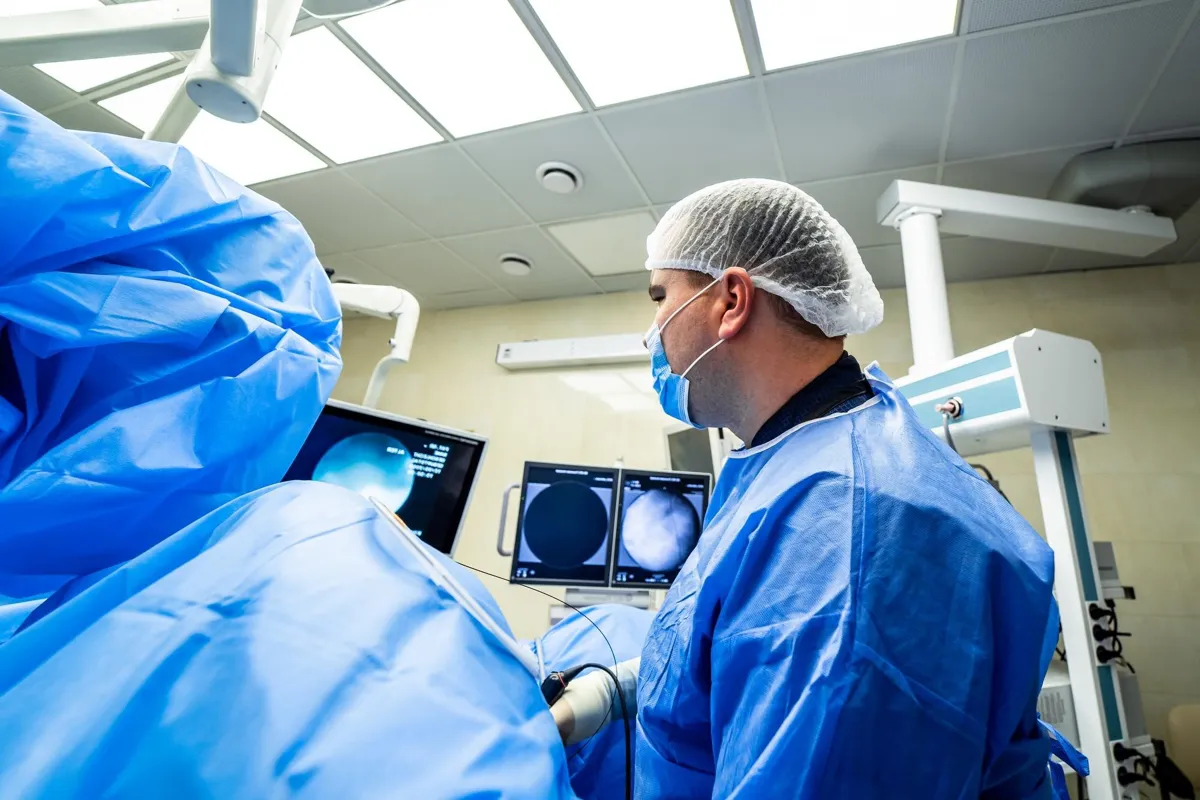
Under general anesthesia, the urologist makes an image-guided puncture in the back to reach the inside of the kidney. Through this small access, a nephroscope is inserted, the stone is fragmented and the fragments are removed.
At the end of the procedure, a nephrostomy tube, a double J stent or no drain may be left, depending on the case. If a fragment remains, it is sometimes removed in a second procedure through the same access.
When it is indicated
- Kidney stones larger than 20 mm
- Partial or complete staghorn stones
- Lower pole stones of 10 to 20 mm with unfavorable anatomy or density
- Stones that were not resolved with lithotripsy or ureteroscopy
How well percutaneous surgery clears stones
Percentage of stone-free patients in published studies.
CROES global study, 5,803 patients
75.7%
stone-free 30 days after percutaneous surgery, in 96 centers on five continents.
Staghorn stones, AUA guideline
78%
stone-free with percutaneous surgery, compared with 54% with shock wave lithotripsy.
Lower pole, randomized trial
95%
with percutaneous surgery, compared with 37% with lithotripsy; in stones larger than 10 mm, lithotripsy fell to 21%.
In stones of 20 to 30 mm, a Colombian study published in 2022 in the journal Urología Colombiana found percutaneous surgery cost-effective compared with flexible ureteroscopy.
After percutaneous surgery
By phase
Day of surgery
General anesthesia and hospital stay
You may leave with a nephrostomy tube, a double J stent or no drain.
Days 1 to 3
Hospital discharge
Depending on complexity. The nephrostomy tube, if one was left, is usually removed before discharge.
First weeks
Pink urine and discomfort at the puncture site
No physical exertion until the urologist indicates otherwise.
Follow-up
Imaging and stone analysis
It confirms that no fragments remain; if any do, a second procedure is considered.
Returning to work
There is no single published timeframe; it depends on the complexity and the type of work you do. The urologist will advise you at the follow-up visit.
When to seek medical care
Fever, heavy bleeding in the urine or from the wound, or pain that does not subside.
Preventing recurrence
For large or infection stones, the metabolic evaluation guides prevention.
Side effects and risks of percutaneous surgery
Most complications are mild. Before surgery, any infection is treated and anticoagulants are adjusted to reduce the risk of bleeding.
Side effects and complications
- Any complication, mostly mild20.5%
- Fever after surgery10.5%
- Blood transfusion5.7%
10.5%
Fever
The most frequent complication in the CROES global study; it is treated with antibiotics.
5.7%
Transfusion
Bleeding is the main risk; for this reason, the anticoagulant is adjusted beforehand with your treating physician.
Percutaneous surgery compared with other techniques
The four ways of treating a stone, with their reference price and the stone size for which they are usually indicated.
Medical management and stone passage
Reference price
From COP 250,000 (US$63)
Stone size
Ureter, up to 10 mm
No procedure
Shock wave lithotripsy
Reference price
From COP 4,500,000 (US$1,125)
Stone size
Up to 20 mm, low density
Outpatient
Laser ureteroscopy
Reference price
From COP 8,000,000 (US$2,000)
Stone size
Ureter of any size and kidney up to 20 mm
Same day or one night
Percutaneous nephrolithotomy
Reference price
From COP 14,000,000 (US$3,500)
Stone size
Kidney, larger than 20 mm or staghorn
1 to 3 days
Your percutaneous surgery in Medellín, step by step
The urologist determines how many days you should stay in Medellín based on the technique and whether a stent is left. We coordinate the schedule so that tests, procedure and follow-up take as few days as possible.
Step 1
Contact by WhatsApp
Send us your ultrasound or CT scan and tell us about your symptoms.
Step 2
Case review
The urologist reviews your images and proposes the technique that is usually indicated.
Step 3
Pending tests
Uro-CT, urinalysis and creatinine, if you do not have them yet; they can be done on arrival.
Step 4
Formal quote
With details of what it includes, in pesos or in dollars.
Step 5
Surgery and hospital stay
1 to 3 days in the clinic and, after discharge, the option of a recovery house at COP 759,900 per night.
Step 6
Follow-up and return
Follow-up with imaging and, if a stent was left, its removal before you travel.
What MDE Care does for you
We are neither a clinic nor a directory. We support you from your first question to the results consultation.
Initial guidance
We review your medical order or the reason for your visit before booking.
The right specialist
We connect you with the urologist who performs the procedure you need.
Clear prices
You know the price and what it includes before booking.
Appointments and tests
We coordinate the schedule, the preparation and the timing of each step.
Logistics support
Lodging and transportation if you are coming from another city or country.
Follow-up
We coordinate the results consultation and follow-up visits.
About percutaneous nephrolithotomy
How much does percutaneous nephrolithotomy cost in Medellín?
When is it indicated instead of ureteroscopy?
Does it leave a scar?
How many days of hospital stay does it require?
What is a nephrostomy tube?
What are the risks of percutaneous surgery?
Can you travel after the surgery?
Other urology pages
Request your assessment for percutaneous nephrolithotomy
Send us your CT scan. We will tell you the complexity usually estimated in your case, the number of days of stay and the price before you travel.