
Keratoconus treatment in Medellín
Stop keratoconus from progressing in time and regain quality of vision, with cornea specialists
Keratoconus thins the cornea and gradually changes its shape. Depending on the stage, it is corrected with specialty lenses, halted with crosslinking, reshaped with intracorneal rings and, only in advanced cases, treated with a corneal transplant. MDE Care is not a clinic: we arrange your assessment with the cornea specialist, your tests and your treatment in Medellín.

What changes the outlook
knowing whether it is progressing
Which stage is your keratoconus at?
Answer a few questions and we will tell you which step usually applies, what is checked at the assessment and how much that step costs.
1What is your situation?
2How old are you?
3Were you told it is progressing?
4Do you tolerate contact lenses?
5Do you rub your eyes or have eye allergies?
Serial check-ups to see if it is progressing
You have a diagnosis but do not know whether it is progressing. That is what defines the treatment: repeating the topography or tomography and comparing it with earlier scans shows whether it needs to be halted. Your age group is when the disease tends to progress.
Usually applies
- Assessment with the cornea specialist
- Topography or tomography to compare
- Depending on the result: lenses, crosslinking or rings
What is checked
- Corneal topography or tomography
- Comparison with previous measurements
- Pachymetry: corneal thickness
Follow-up assessment, estimated price
COP 420,000to COP 800,000
The test alone, both eyes: COP 100,000 to COP 200,000.
* Estimated prices, confirmed at your assessment. Guidance only, not a diagnosis.
How much keratoconus treatment costs in Medellín
Build your case: the cornea assessment, the treatment you were recommended and whether it is for one eye or both. We show you the estimated total in pesos or dollars.
First, the assessment
Everything starts with a consultation with the cornea specialist and a corneal topography or tomography: they confirm the diagnosis, measure corneal thickness and decide whether to correct, halt or reshape.
What is included
- Consultation with the cornea specialist
- Topography or tomography of both eyes
- Treatment plan
What changes the price
- Whether topography is enough or tomography is needed
- Whether the keratoconus is progressing and needs treatment
- The assigned clinic and specialist
1. Cornea assessment
2. Treatment
The specialist chooses the treatment based on your topography, your corneal thickness and whether the keratoconus is progressing.
Estimated total
COP 420,000to COP 800,000
Cornea assessment
Cornea assessment
COP 420,000 to COP 800,000
Breakdown
- Cornea assessment with topography or tomographyCOP 420,000 to COP 800,000
* Estimated prices, confirmed at your assessment. Guidance only, not a diagnosis.
What keratoconus is
Keratoconus is a disease in which the cornea, the clear layer at the front of the eye, thins and bulges outward into a cone shape. That change in shape distorts vision.
It usually appears between adolescence and age 20, and it can progress for 10 to 20 years before it stops.
Keratoconus does not mean a transplant. In the early stages vision is corrected with glasses or soft lenses and, when the cornea changes shape further, with specialty rigid lenses. A transplant is reserved for severe cases and most people never need one.
Signs of an eye with keratoconus
Keratoconus progresses without pain, so it helps to know the signs that give it away.
How keratoconus is diagnosed
It does not rely on a single test. Several measurements are combined to confirm the disease and see whether it is progressing.
Corneal topography or tomography
A map of the curvature and thickness of the cornea. It is the basis for confirming the diagnosis and deciding whether you are a candidate for treatment.
Pachymetry
Measures corneal thickness. It is key because standard crosslinking requires a minimum thickness of 400 microns.
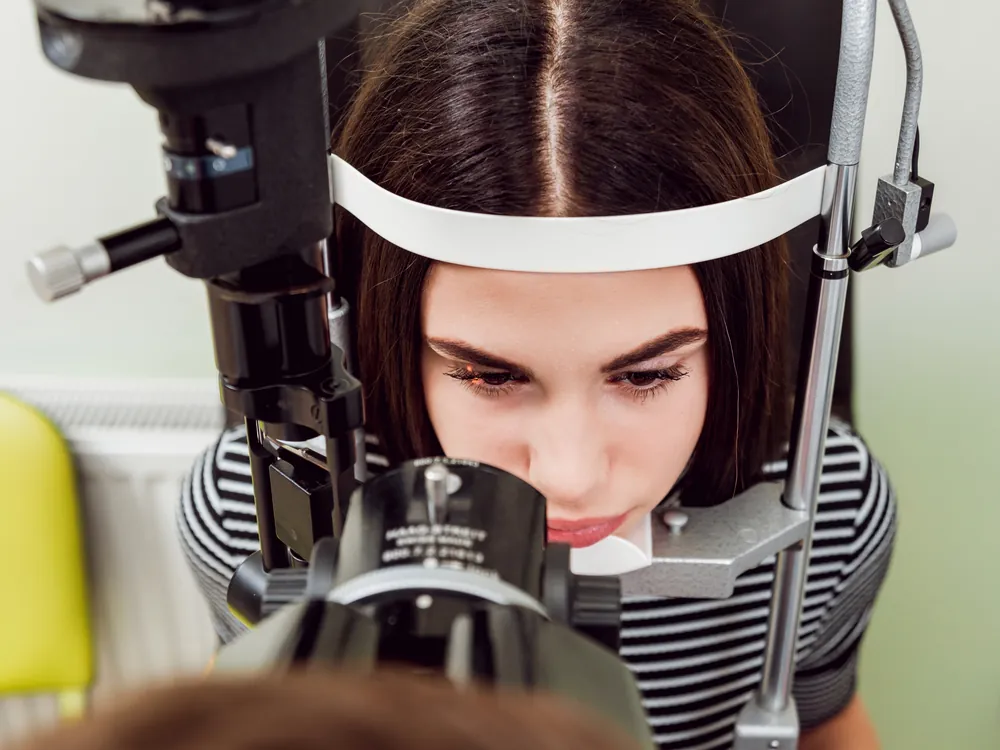
Refraction and slit lamp exam
Frequent prescription changes, especially in astigmatism, are typical of keratoconus. The slit lamp gives a close look at the layers of the cornea.
Serial check-ups
Repeating the measurements over time documents whether the disease is progressing, which is what decides whether crosslinking is indicated.
If you do not have a diagnosis yet and only notice that your vision is changing, start with a full eye assessment.
Keratoconus treatments, explained plainly
Each treatment does something different. Knowing what it achieves and what it does not avoids false expectations.
Specialty lenses
Soft lenses in early stages; rigid or scleral lenses when the cornea changes shape further. They correct vision but do not stop the disease.
Rigid, per pair: COP 800,000 to COP 1,750,000
Corneal crosslinking
Riboflavin (vitamin B2) drops followed by ultraviolet light stiffen the cornea so it stops bulging. It halts progression but does not restore lost vision.
COP 5,000,000 to COP 8,000,000 per eye
Intracorneal rings
Intacs or Ferrara type segments implanted inside the cornea to flatten it and improve vision. They do not stop progression, which is why they are sometimes combined with crosslinking.
COP 5,000,000 to COP 10,000,000 per eye
Corneal transplant
The last resort, for advanced cases or when there is scarring. In keratoconus usually only the front layers of the cornea are replaced.
Quoted at your assessment
Estimated prices, confirmed at your assessment.
Who is a candidate for crosslinking
Corneal transplant: when and how
It is considered in advanced keratoconus that can no longer be corrected with lenses, or when scarring remains. In mild or moderate cases, specialty lenses, crosslinking or rings are tried first.
Layer by layer, when possible
The DALK technique replaces the front and middle layers and keeps the patient’s inner layer. It is common in keratoconus and carries a lower risk of rejection.
Full thickness, if all layers are damaged
Penetrating keratoplasty replaces the full thickness of the cornea with donor tissue. It is an outpatient procedure: you go home the same day.
A long recovery
Vision returns gradually; after a penetrating transplant it can take a year or more. Stitches are removed at check-ups and some stay for up to a year.
Signs of rejection: get seen the same day
Rejection is the main risk and it can be treated if caught early. Contact your surgeon without waiting for the next check-up if you notice:
- Pain in the operated eye
- Sensitivity to light
- A red eye
- Cloudy or hazy vision
With treatment: what changes and what does not
The cornea does not return to its original shape
No treatment restores it to how it was. Progression can be halted and vision improved.
Crosslinking stabilizes, it does not correct
In some cases it flattens the cornea slightly, but it does not replace glasses or contact lenses.
Temporary haze after crosslinking
It is common in the following weeks. In a minority of cases it can become permanent, which is why there are check-ups.
Check-ups, some of them remote
Topographies are repeated to confirm the cornea has stabilized. Later check-ups can be done remotely when the specialist considers it safe.
Keratoconus at a glance
| Key test | Corneal topography or tomography, both eyes: COP 100,000 to COP 200,000 |
|---|---|
| Cornea assessment | Consultation with the specialist plus topography or tomography: COP 420,000 to COP 800,000 |
| Goal of crosslinking | Halting progression. It does not restore lost vision |
| Standard protocol | About 30 minutes of riboflavin drops and another 30 minutes of ultraviolet light |
| Corneal requirement | Minimum thickness of 400 microns for the standard protocol |
| Check-ups | Repeated topographies; later ones can be done remotely when the specialist considers it safe |
Why arrange your keratoconus treatment with MDE Care
We are not a clinic: we are your coordination team. We connect you with cornea specialists and accredited clinics in Medellín.
Straight to the cornea specialist
Your assessment is with an ophthalmologist dedicated to the cornea, with the tests keratoconus needs.
A clear price for each step
You know from the start what the assessment, lenses, crosslinking or rings cost.
Coordination from start to finish
Assessment, treatment, check-ups and, if you travel, the logistics of your stay in Medellín.
Organizations that support our work


How we coordinate your keratoconus care
A guided process from your first message to your check-ups.
Tell us about your case
Message us on WhatsApp with your topography, prescription or diagnosis.
Assessment
Consultation with the cornea specialist and topography or tomography.
Plan
Lenses, crosslinking, rings or transplant, with a clear price.
Treatment
We arrange the appointment, the clinic and your stay if you travel.
Check-ups
In person and remote when the specialist considers it safe.
The most common questions about keratoconus
Can keratoconus be cured?
How much does crosslinking cost in Medellín?
How much do intracorneal rings cost?
Does crosslinking improve vision?
Which lenses work for keratoconus?
When is a corneal transplant needed?
Does rubbing my eyes make keratoconus worse?
How much does corneal topography cost?
Already have a topography?
Send us your scan and we will help you book with the cornea specialist.
Other ophthalmology procedures
Ready for your keratoconus assessment?
Write to us with your topography, prescription or diagnosis. We arrange your assessment with the cornea specialist, your treatment and your check-ups in Medellín, with a clear price from the first message.